Healthcare retention starts with redesign, not recruitment

Healthcare workers haven’t fallen out of love with what they do — they’ve fallen out of alignment with how it’s structured. Here’s how industry leaders can make the profession worth staying for.
Key takeaways
- Burnout and overwork – not a lack of purpose or passion – are driving healthcare workers away.
- Retention starts with redesigning systems that sustain employees, not persuading them to stay.
- TA and HR leaders can rebuild trust and stability by improving work wellbeing from the first touchpoint.
Healthcare and social assistance is Australia’s largest employing industry, and pressure is mounting as demand outpaces local supply. Retention hinges on redesign, not recruitment alone: only 25% of Australian workers are 'thriving' at work (happy, fulfilled, low‑stress and satisfied).
What’s pushing people isn’t a loss of purpose, it’s pressure. For Australians, work is the number one daily stressor (among top life stressors), which underscores the need for predictable rosters, real support and stronger connection if we want people to stay.
Ready to get started?
Explore the insightsA system under pressure
Healthcare has long rewarded overwork, often confusing it for dedication. Chronic understaffing, administrative overload and limited advancement opportunities are driving many workers to question their future in the field. The global story aligns with the Australian picture: only 1 in 4 Australian workers are 'thriving' at work (happy, fulfilled, low‑stress and satisfied) , a cleara clear signal that roles aren’t designed for sustainable energy, belonging and trust.
While global surveys cite pay, staffing and growth as top sources of dissatisfaction, the Australian signal rhymes in a different cut: work is Australians’ number one daily stressor (among top life stressors), compounding the load and accelerating attrition when staffing and support fall short.
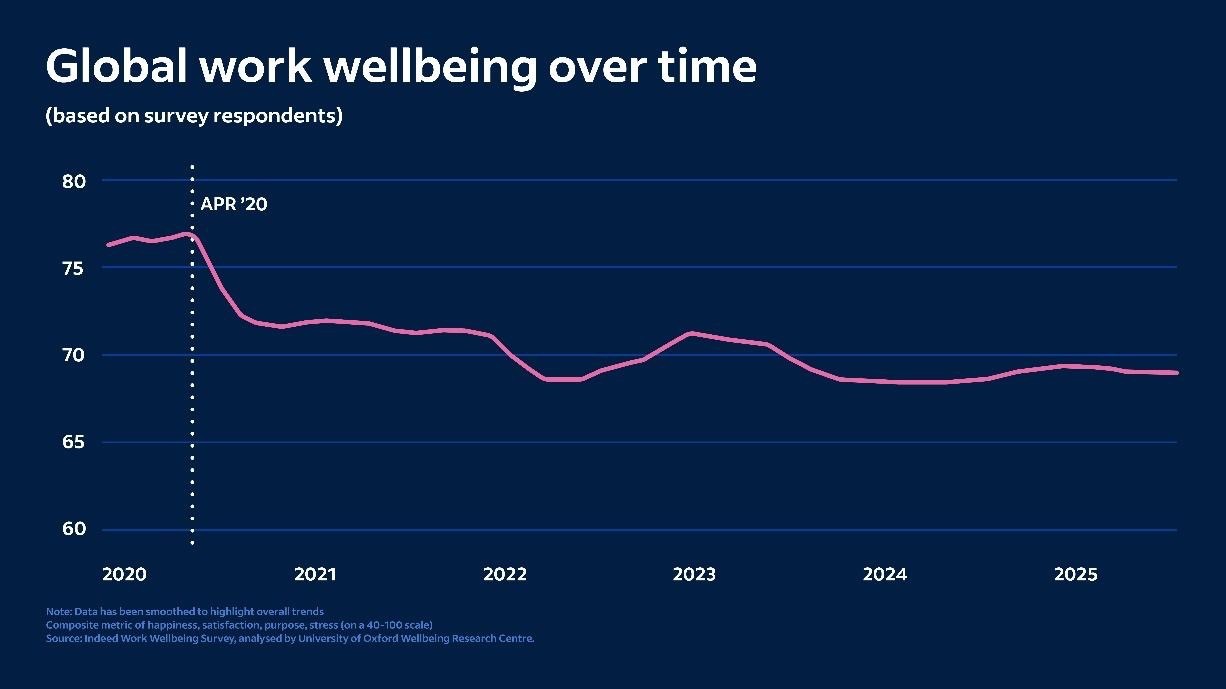
Caption: Indeed’s Work Wellbeing Score indicates that work wellbeing peaked during April 2020.
Healthcare worker wellbeing briefly peaked during the COVID pandemic. In April 2020, they felt more valued than ever: People cheered for them in public, managers offered support and a strong sense of purpose fueled their work. But that appreciation soon faded. Once the applause stopped, the same cracks that existed before the pandemic widened. The systems never fully recovered, and many people holding them up didn’t either. In Australia, the pattern adds a twist: expectations for wellbeing have risen, but the share of people 'thriving' remains low, widening the expectation–experience gap unless work is redesigned for predictability, support and connection.
Overwork isn’t just a staffing issue; it’s a sustainability issue. When companies reward overwork with overtime pay and praise, they create a cycle that reinforces burnout. The result is a shrinking workforce where experienced professionals exit faster than new ones can enter. The Australian antidote is practical and evidence‑led: design for the core drivers of work wellbeing — day‑to‑day energy, belonging and trust — which are most strongly linked to better outcomes locally.
Redesigning work to retain healthcare talent
Healthcare retention is about making the job worth staying for and that starts long before the first shift. Every touchpoint shapes how healthcare workers see your organisation, from the job ad that signals your values to the onboarding experience that sets the tone. In Australia, that means designing around what most strongly predicts staying power: day‑to‑day energy, belonging and trust.
Too often, job ads emphasise 'resilience', 'multitasking' and 'fast-paced environments', signalling that burnout is part of the deal. For Australian audiences, a copy that highlights concrete supports clinical supervision, preceptorship, safe staffing commitments, protected learning time and team‑based care communicates sustainability. It also speaks directly to what lifts the AU wellbeing drivers: energy (less low‑value admin, more clinical time), belonging (stable teams, mentorship) and trust (clear rosters, safe staffing principles).
Indeed’s 2025 healthcare report shows that 2 in 3 healthcare workers are unsatisfied with their current jobs, but those who are satisfied cite supportive teams and human connection as their biggest reasons to stay.
In other words: belonging is the new benefit.
Belonging is the new benefit.
When healthcare organisations invest in belonging, they build trust and connection that outlast even the toughest shifts. Workers who feel connected to their colleagues and leaders are more likely to stay, even when the work is demanding.
Building alignment through human-centred design
Despite sharing a mission to provide care, healthcare employers and workers often have different priorities. Alignment starts with listening to your people – not to confirm what company leaders believe, but to understand what your employees actually experience.
Human-centred hiring
Participants agreed that happiness and purpose start with the first impression. In Australia, that means revising job ads and career pages to reflect belonging, teamwork and values, and adding manager‑led welcome calls or day‑in‑the‑life videos helping candidates feel seen and imagine themselves in the role, while signalling safe staffing principles, roster predictability and mentorship that build trust and belonging from day one.
Purpose in practice
Half of healthcare workers globally cite patient relationships as their top source of satisfaction; in Australia, leaders translate that into mission‑led onboarding, real patient stories and cross‑department shadowing paired with protected clinical time so purpose isn’t buried under paperwork, lifting day‑to‑day energy
Predictability and support
Many ideas centred on reducing stress through stability, such as consistent schedules, earlier notice of shift changes and 90‑day peer mentorships. This matters in Australia because work is the number one daily stressor (among top life stressors), so predictability and genuine access to leave show respect for life beyond work and reduce churn risk.
Psychological safety
People stay where they can speak up and see change happen. Leaders recommended emotional check‑ins in huddles and supervision, manager training to spot burnout early, and closing the loop on anonymous pulse surveys with visible actions and timelines practical ways to strengthen belonging and trust in Australian settings.
Across every idea, one truth remains: retention grows from everyday acts of care. When employers and employees co‑design better systems and leadership acts on employee insight, work wellbeing becomes a lived culture in Australia, not a policy, because daily experience improves on energy, belonging and trust.
From healthcare burnout to belonging
Improving healthcare retention requires structural change, but it doesn’t depend on sweeping strategies. It’s built through everyday choices: a manager who listens without judgement, a peer who models flexibility, a recruiter who writes job ads emphasising sustainability over speed. These moments build trust, and trust builds tenure.
Talent leaders have the power to shape the future of care by designing systems that support both wellbeing and efficiency, enabling healthcare workers to help others without losing themselves in the process. By prioritising aspects like human connection, professional support, recognition and balanced workloads, you can turn crisis into connection.
Because in healthcare, the question isn’t whether people want to stay — it’s whether we give them a reason to.
Indeed provides this information as a courtesy to users of this site. Please note that we are not your recruiting or legal advisor; we are not responsible for the content of your job descriptions; and none of the information provided herein guarantees performance.
_____
Related links
Australia’s Healthcare Talent Crunch: How International Recruitment Can Bridge the Gap
Ready to get started?
Explore the insights
Ready to get started?
Get insights and inspiration for the modern world of work
We’ll be in touch soon with the insights and inspiration you need to lead a thriving workforce.


