Indeed FutureWorks 2023: Five trends shaping today’s evolving labour market

This article is a translation of an original article in English. Links and data points from the original article have been left unadapted.
In a particularly packed session at Indeed FutureWorks 2023 on 21 September, Svenja Gudell, Chief Economist of Indeed’s economic research arm Hiring Lab, delivered insights about future labour market trends, featuring brand new Hiring Lab AI research released that very morning. Notably, she addressed a common fear that’s been growing since the recent rise of AI began: “When we talked about automation before, we talked about manual labour being replaced by automation.… All of a sudden, we're talking knowledge workers being impacted.”
But for those worried about AI taking their jobs, or whether or not they need to prepare for a recession, Indeed Hiring Lab has some good news. Here are the five top takeaways from Gudell’s standing-room-only FutureWorks 2023 presentation.
Get quality candidates when you post with Sponsored Jobs
Learn moreLabour demand is cooling …
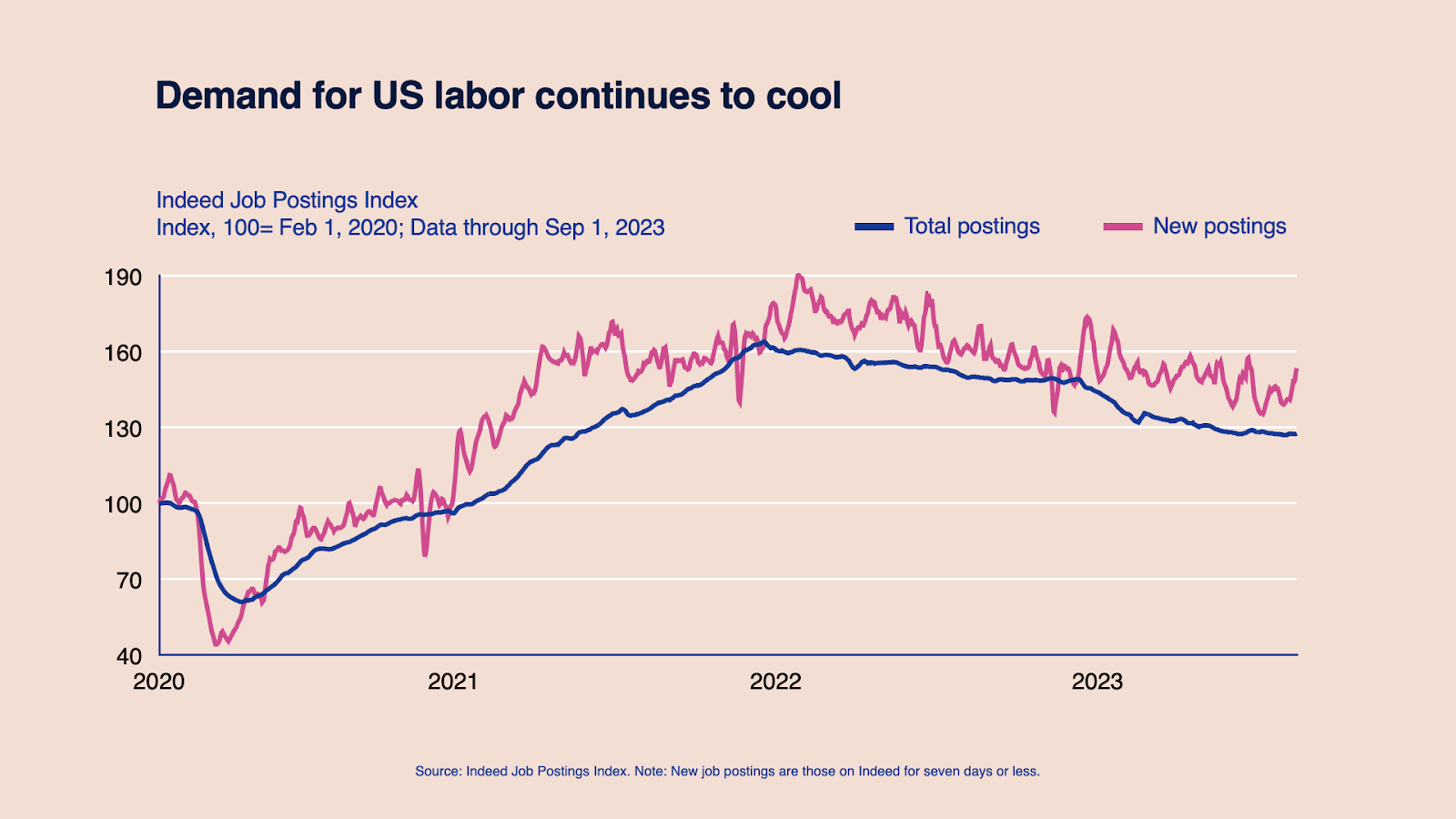
To gauge labour demand, Hiring Lab looks at the Indeed Job Postings Index, which tracks total job postings on Indeed compared to new postings since February 2020. As employers know all too well, the labour market has been tight and remains tight, currently with 1.5 open positions for every unemployed worker.
Following the initial dip in demand in February 2020, the market gradually rebounded and peaked in early 2022. Since then, it has been on a gradual decline.
Gudell drilled down to reveal the impact across different occupational sectors, including software development and marketing. In each of those sectors, hiring increased during 2022 and has since reached pre-pandemic levels of demand.
However, following an initial pandemic-related dip, increased demand for customer-facing occupations like nursing or food preparation has remained consistent.
… But the market is hot
“Now, I think we can officially call this one: the Great Resignation is over,” Gudell said to an audible “Woo!” and applause from the audience. Quit rates have now returned to pre-pandemic levels – although pre-pandemic rates were already elevated.
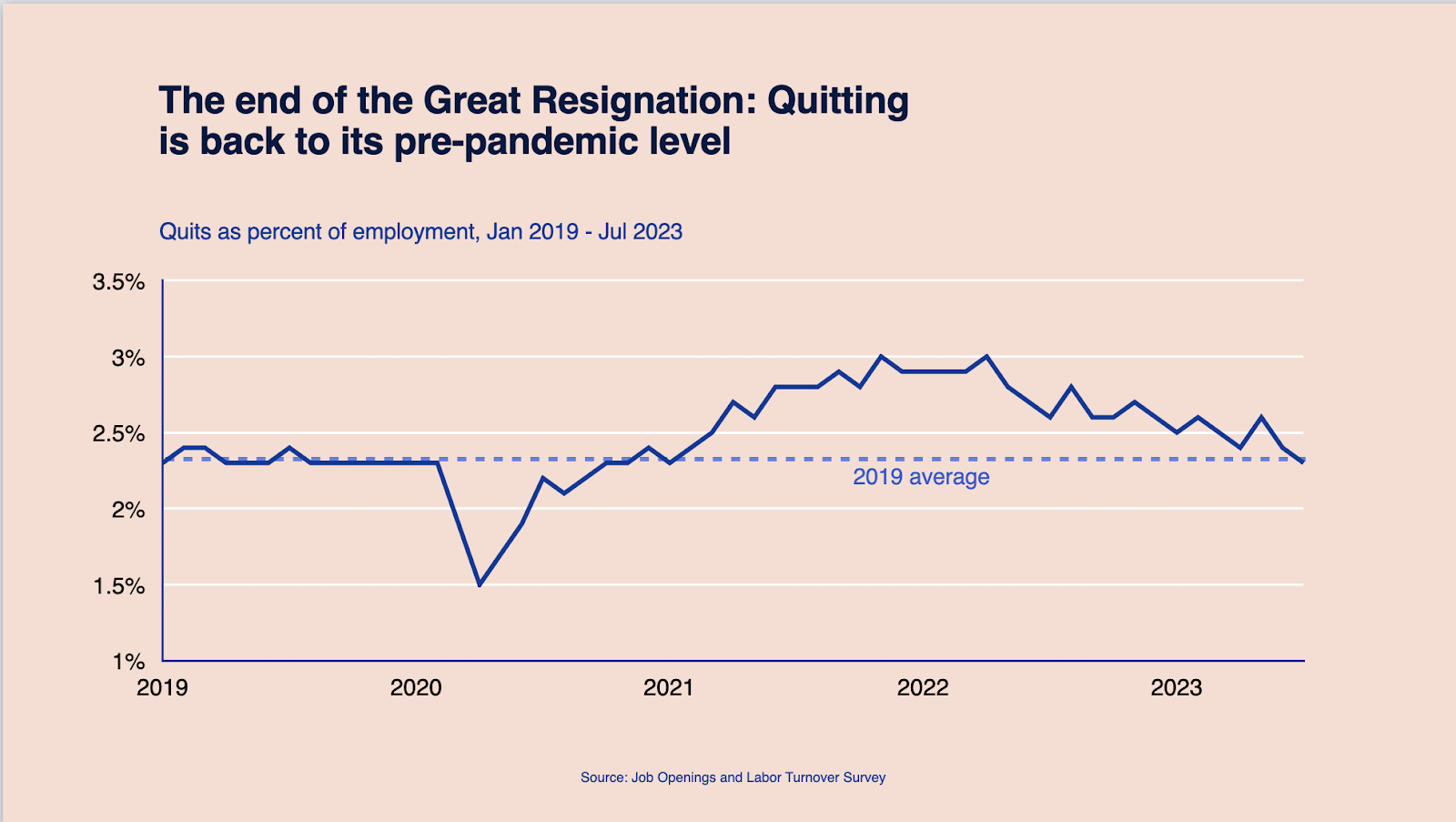
During the pandemic, people exited the job market for a variety of reasons, including illness, company layoffs or caregiving responsibilities, making it difficult for many groups (especially women) to return to work. “All that means is that this reacceleration of labour supply took us a while, but it's looking quite good, particularly compared to historical standards,” Gudell said.
Overall, Gudell said, all evidence points to a strong labour market. “Not as hot as it used to be, but it's still a pretty hot market,” she concluded.
Wage growth ahead of inflation
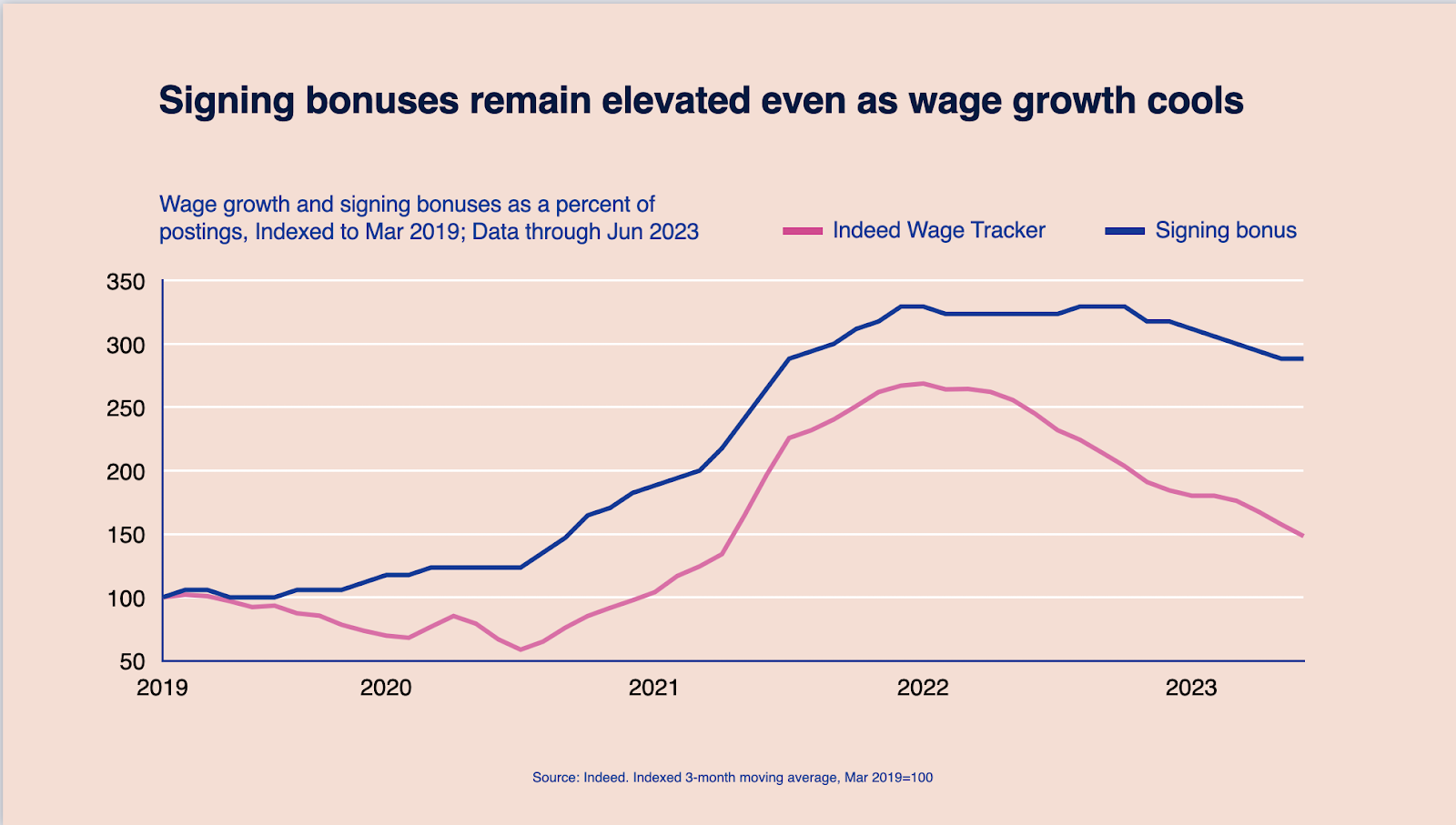
As the labour market cools, wage growth is also slowing. However, in great news for workers, wages are still growing faster than inflation. (Gudell used Indeed’s new wage tracker to measure wage growth – you can download this data set for free and learn more about its methodology.)
But pay doesn’t tell the full story of compensation. Hiring Lab’s research shows that employers are still widely offering signing bonuses, especially in nursing, without any sign of stopping.
Caption:
Recession – Will we or won’t we?
One of the concerns at the forefront of everyone's mind, worker and employer alike, is the likelihood of recession. To break down what data informs Hiring Lab’s recession forecasting, Gudell began by analysing consumer spending trends.
She charted how, after the initial shock of the pandemic, personal spending on goods grew, with services later picking up with the advent of COVID-19 vaccines. Now, consumer spending in both sectors is at a healthy rate.
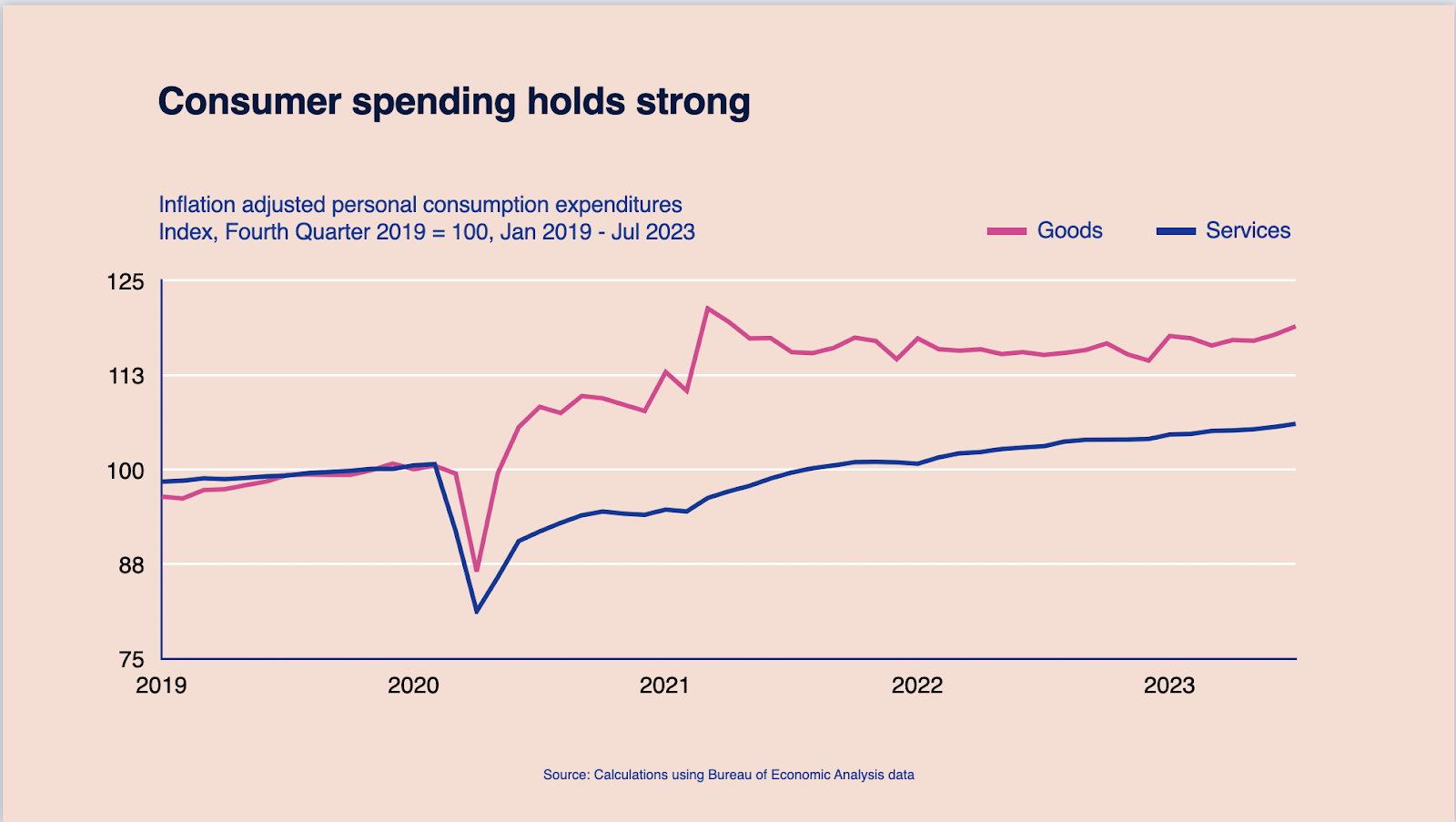
“Interestingly enough, we didn't switch off goods for services as much as many economists thought we would,” Gudell said. “This, of course, fuels the labour market quite a bit. As long as this picture holds true, our economy's still holding strong.”
She also measured recession risk by looking at unemployment and layoffs, as both tend to increase in a recession. When looking at all jobs across the US, she said, layoffs aren’t as responsible for the rising unemployment rate as recurring headlines make it seem.
The uptick in the unemployment rate is mostly driven by more people entering the labour force and searching for a new job, not by workers losing their jobs. And at a rate of 3.8%, unemployment is still incredibly low – “like, blow-your-mind low,” Gudell said.
“But we're all in a business cycle here so, at some point, the recession will come,” she added. “But for right now, we don't think it's happening anytime soon.”
Can AI do your job? Maybe — but not well
Gudell rounded out the session by revealing results from Indeed Hiring Lab’s 'AI at Work' series of research reports. One aspect of the series looks at how GenAI is going to impact jobs using Hiring Lab’s Generative AI Job Tracker, which tracks Indeed job posts that mention the term 'Generative AI' and other related keywords somewhere in their job description.
The research showed that, despite a steep increase since last year, GenAI jobs still account for less than 1% of all job postings. While professionals are at the early stages of building and using these tools, Indeed’s AI survey of HR and talent acquisition leaders shows that 87% are currently using AI in some shape or form. This speaks to what kind of impact we might see in the future.
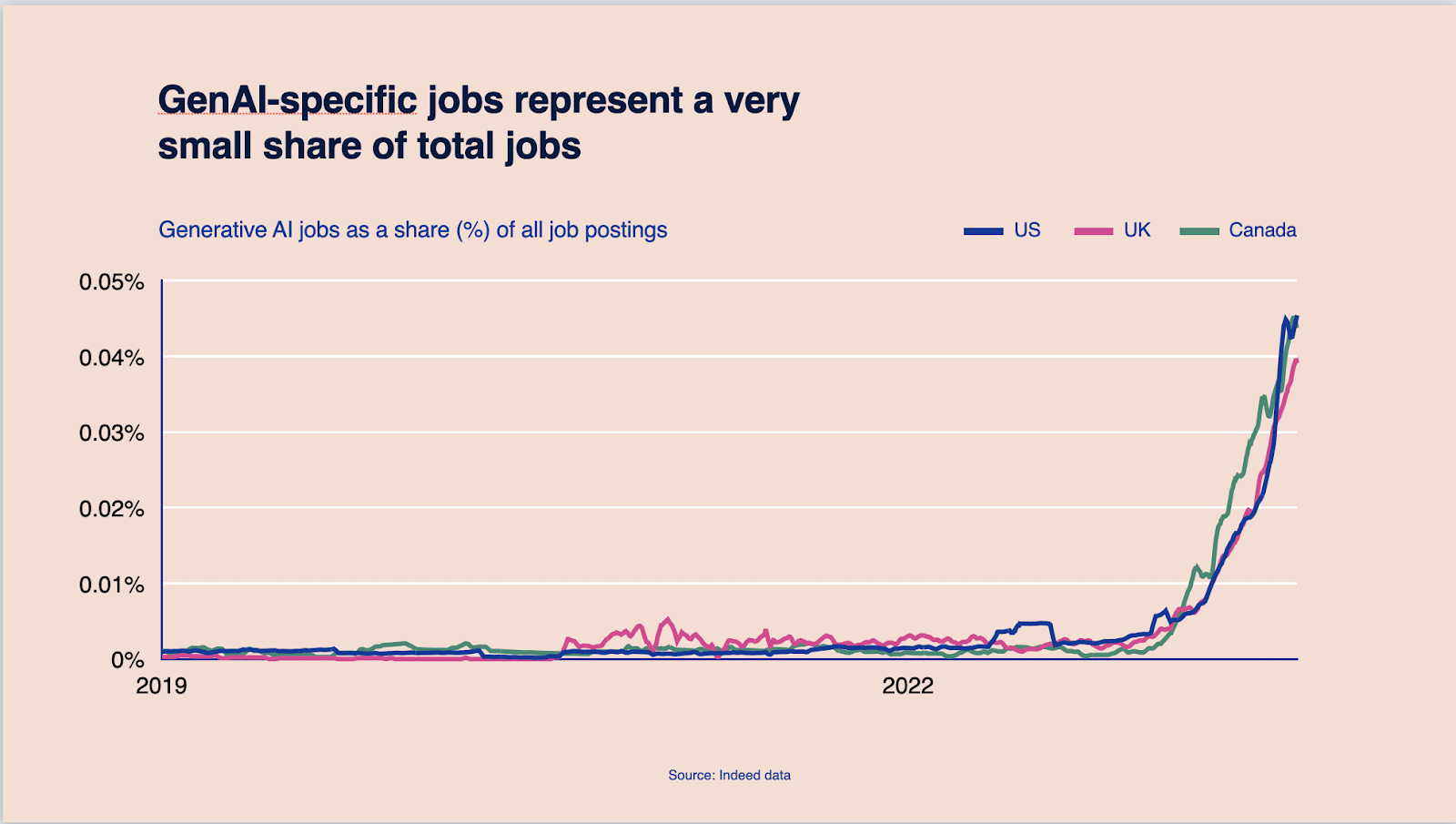
In the AI at Work Report, Hiring Lab analysed more than 55 million job postings on Indeed and more than 2,600 skills to identify the impact GenAI will have on jobs across different sectors and the skills required to perform them.
The main takeaway? Humans aren’t going away anytime soon. The research team found that one in five jobs they looked at had a high exposure to GenAI, meaning GenAI could do 80% or more of the skills needed to perform the job. Their findings show that, even though GenAI virtually touches every job out there, the technology at this point is not good enough to perform a job single-handedly.
GenAI has high potential to impact jobs in fields like law, HR and marketing. Generally, in roles that require human interaction, like driving or childcare, GenAI is not as helpful. In fact, there is a high correlation between remote work and GenAI’s potential impact. However, Gudell noted, knowledge workers can also use AI as a tool to enhance their productivity and eliminate busywork so they can focus on the more enjoyable aspects of their job.
“A lot of times, what GenAI could help you with are repeatable tasks or summarising something, but it's not going to take over your critical thinking, your empathy, your leadership – what you have to show up with when you're interacting with other people,” Gudell said.
Gudell concluded with optimism as to how AI technology will improve work. “I definitely think there's going to be change here and that change is going to be hard,” she said. “We're going to lose some jobs but, if history has taught us anything, this advancement in technology will also give us a whole lot of new jobs along the way.”
For more from the 'AI at Work' series and continued updates on the labour market, visit Indeed Hiring Lab.
Get quality candidates when you post with Sponsored Jobs
Learn more
Ready to get started?
Get insights and inspiration for the modern world of work
We’ll be in touch soon with the insights and inspiration you need to lead a thriving workforce.


