No Job Seeker Left Behind: 3 Steps to a Broader Talent Pool

An essential part of my work as Indeed’s SVP of Environmental, Social and Governance is breaking down bias and barriers in the hiring process. For me, it’s not just a corporate responsibility – it’s personal.
I’ve been working since I was 14, sometimes two jobs at a time. I never had an internship; I began my career in operations roles at startups during the first dot-com bubble. But when that bubble burst, I was laid off for the first time in my life. I was jobless for six months, despite my best efforts to find a new position. I had to move back in with my parents. I couldn’t sustain myself and my son on my own, and I was ashamed.
Why was it so difficult for someone with skills and experience like mine to successfully find employment? I was turned down over and over again because I don’t have a college degree.
When I finally did land a job (thanks to a friend), I went from making $90,000 a year to $11.75 an hour. This is why making work more accessible and equitable is so important to me.
I understand what it’s like to face barriers to employment, to be evaluated on credentials versus skill and to feel like the world of work has left me behind. If I’ve felt this way, imagine how many millions of talented job seekers are out there who, just like me, have been underappreciated, underestimated and overlooked because they can’t tick the right box on a job application.
Imagine how much untapped talent your company is missing out on.
Get quality candidates when you post with Sponsored Jobs
Learn moreThe World of Work Is Broken for Many. But We Can Fix It.
New approaches to recruiting are a necessity in today’s volatile talent landscape. Employer demand for workers is going strong, despite the rising layoffs and general unease about an impending global recession. Voluntary resignations remain high, with one in five workers planning to quit by the end of this year.
Recent Indeed Hiring Lab data shows that job postings on the site are 141% ahead of their pre-pandemic baseline. Meanwhile, job seekers and consumers alike are gravitating to companies and brands that not only support but create actionable change. In this environment, recruiting strategies that were once 'good enough' are now looking threadbare and tired.
This is the moment to build a future of better work for everyone by hiring outside the box. Where some companies will continue to feel the labour market crunch, others will seize this opportunity to adapt and grow. Organisations that thrive will widen their talent pools by welcoming untapped talent who have historically faced barriers to employment.
Here are three ways to break down some common barriers – not only for those without post-secondary degrees, but also for people with criminal records and people with disabilities – in order to fuel business growth and build a future of better work for all.
1. Promote skills-based hiring
With skills-based hiring, job applicants are assessed based on their competency, abilities and proven performance, not just degrees. This approach not only offers opportunities for a number of qualified workers who need jobs but it also provides employers with a much wider pool of eager, trainable talent with transferable skills and backgrounds.
For example, an experienced barista with a welcoming personality and an entrepreneurial spirit, but no college degree, might have most of the necessary skills needed for a corporate sales role. Unfortunately, many screening systems wouldn’t flag this type of job seeker as a top candidate. Why are we starving our organisations of capable workers, especially when it remains difficult to fill positions? With a skills-based hiring approach, we can change that.
2. Embrace fair chance hiring
Fair chance hiring is centred on the principle that every job seeker has the right to be considered for any role for which they’re qualified. Unfortunately, many who have been impacted by the justice system are not granted that equal opportunity.
Even a misdemeanour or an arrest without a conviction can create lifelong barriers to employment. Over 60% of justice-impacted people in the US suffer from long-term unemployment. For formerly incarcerated individuals specifically, the unemployment rate is estimated at 27%, many times more than that of the general population – even compared to the Great Depression. In addition, mass incarceration disproportionately impacts communities of colour, as well as LGBTQ+ individuals and those with a history of mental illness.
The numbers also show that the justice-impacted are eager for employment. The share of job searches on Indeed using terms like 'no background check' and 'fair chance hiring' have risen 45% since May 2021. Think of all the candidates you’re overlooking by not including these terms in your job descriptions.
It’s not just about the need to offer equal access to employment – it’s about what this talent group has to offer. Employers that embrace fair chance hiring benefit from:
- Reduced turnover. Workers with criminal records are statistically no more likely than workers with no records to be fired for misconduct in many cases. They exhibit higher retention rates and are less likely to quit, saving on hiring costs.
- Reliable performance. Research from the Society of Human Resource Management found that 85% of HR professionals said workers with criminal backgrounds perform 'about the same or better than' other workers.
- Positive impact. Earning a salary, being part of a team, gaining accountability and getting a chance to make a difference – all these factors promote pride and self-esteem, reducing recidivism and benefiting individuals, organisations and society.
The good news: Indeed Hiring Lab data reveals a growing trend toward fair chance hiring: Between May 2019 and May 2022, job postings on Indeed featuring fair chance employment policies grew by more than 30%.
3. Support workplace accessibility
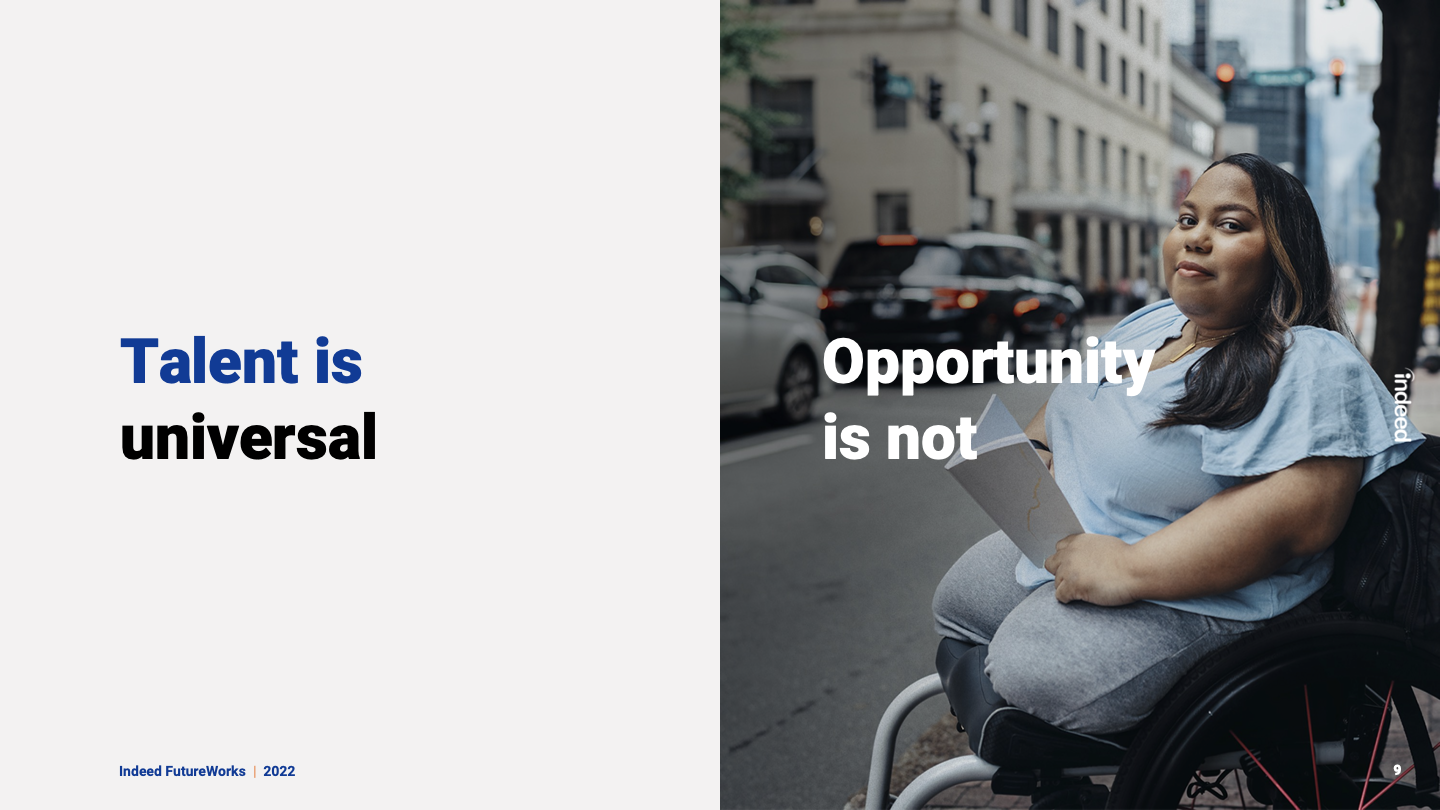
As activist Keely Cat-Wells said at a recent Indeed-hosted lunch and learn, disability is part of the human experience. Many will experience a temporary or long-term disability at some point, or know or care for someone who has. Across all ages and education levels, people with disabilities are more likely to be unemployed than their peers.
Expanding accessibility in the workplace and to employment uncovers a rich source of highly skilled and largely untapped talent that most businesses are overlooking. With technological advancements, as well as changing societal norms and workplace expectations, this is more easily accomplished than ever before.
The pandemic revealed that people can work from home and be fully participating team members, increasing acceptance for remote and hybrid work policies. Meanwhile, new technologies, such as automatic transcripts and closed captioning on video conferencing platforms, are addressing the workplace needs of those with sight and hearing challenges. In addition, application designers and web developers are increasingly delivering products that are fully accessible to screen readers and allow alt text.
By reframing our approach and rethinking what’s possible, we can cast a wider net and expand our talent pool — making the labour market more accessible, one job at a time.
The Future of Better Work Starts With Us
In this moment, everyone has a unique opportunity to rebuild a world where work is equitable, job seekers facing barriers can find better work and everyone has equal opportunity to find jobs they love. That’s why, at Indeed, we’re committed to helping 30 million people globally who face employment barriers find jobs by the year 2030.
But we can’t do it alone.
Join us in rebuilding the future of work by tapping into untapped talent. Together, we can break down bias and barriers to employment and pave the way for a more equitable world of work.
Get quality candidates when you post with Sponsored Jobs
Learn more
Ready to get started?
Get insights and inspiration for the modern world of work
We’ll be in touch soon with the insights and inspiration you need to lead a thriving workforce.


